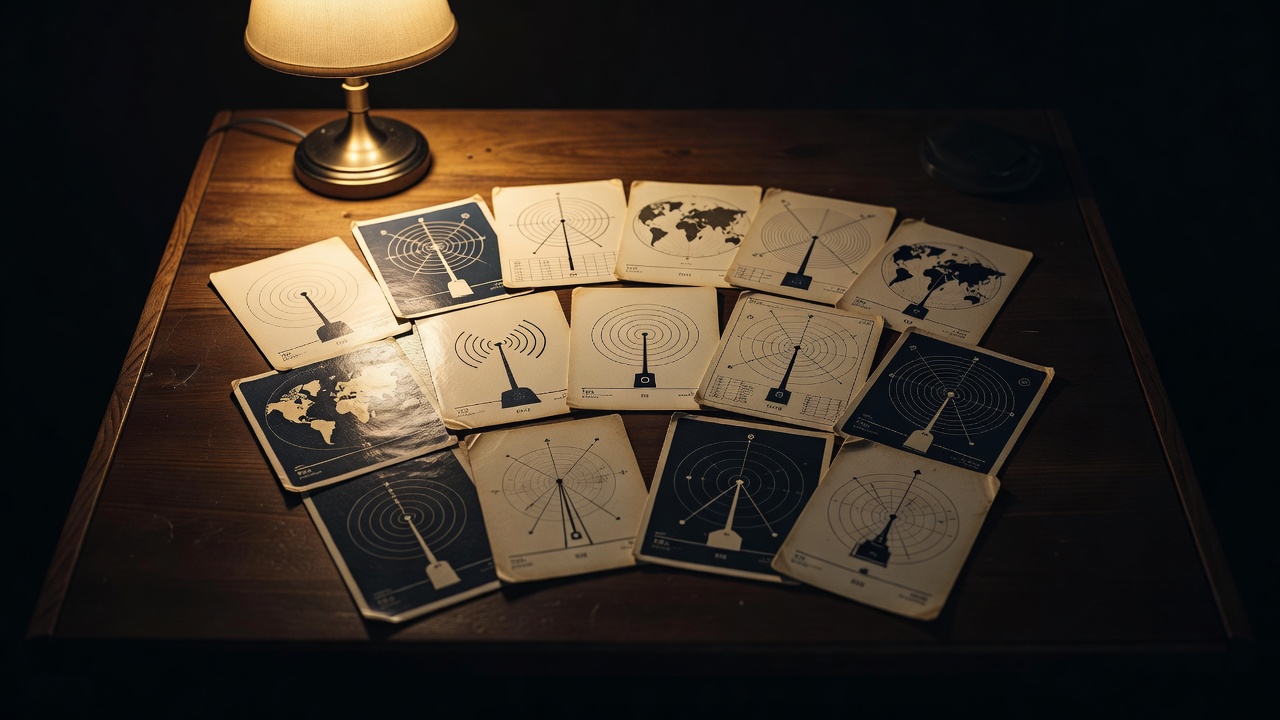
Goal of this stage: turn listening into a record you can search, share and verify. A heard station you did not log is a station you will forget.
4.1 Set up the log
Use a notebook, a spreadsheet or dedicated logging software. Fields, in this order:
- Date (YYYY-MM-DD) and time (UTC)
- Frequency in kHz
- Station and transmitter site, if known
- Language and programme content
- Mode and receiver/antenna used
- SINPO code
- Recording filename
Keep the same format forever. Consistency is what makes a log useful in five years.
4.2 Rate with SINPO
SINPO is the standard five-part reception code, each scored 1 (worst) to 5 (best): Signal strength, Interference from other stations, Noise, Propagation disturbance (fading), and Overall merit. A clear, strong signal might be 54444; a weak, fading one 22322. Be strict. Broadcasters use these reports to judge whether a frequency reaches its target area, so inflated scores are useless to them.
4.3 Write a reception report
A reception report proves you heard a specific broadcast. Include your log fields, a SINPO code, and programme details precise enough to verify — titles of items, names of presenters, a song played at a stated minute. Add a short note about your equipment and location. Keep it to one page. Send by email or the station's web form; many stations prefer short audio clips attached.
4.4 Request the QSL
A QSL card is a station's written confirmation of your report. The term comes from radio Q-code, where QSL means "I acknowledge receipt". Broadcasters such as Radio Romania International and Radio Taiwan International have long issued colourful annual card series; policies change, so check each station's current practice. Amateur radio operators exchange QSLs too, often through eQSL or bureaus run by national societies such as the ARRL and RSGB.
Expect waits of weeks to months. Some stations never reply. That is part of the game.
4.5 Build the gallery
This is the payoff. Scan each card at the same resolution. Name files with date, frequency and station: 2026-02-14_9610kHz_RRI.jpg. Pair each card with its log entry and recording. Over time you build a gallery — a visual map of everywhere your antenna has reached, ordered by date and distance.
4.6 Share responsibly
Publish broadcast logs freely; DX clubs and online communities such as the British DX Club welcome them. Do not publish the content of utility, aviation or private transmissions. Credit other listeners who helped with an identification.
4.7 Loop back to 01
The sequence is a loop. Your log shows which bands work from your location and which are dead. That tells you whether to improve the antenna (stage 01), change your listening hours (stage 02), or chase new signal types (stage 03). Every pass through the line makes the next one better.
Checkpoint
You have completed the sequence when you hold one verified QSL and a log of at least twenty identified stations. Questions? See the query log.