Goal of this stage: turn "a noise at 9 MHz" into "Radio Romania International, English, 2100 UTC". Use the same routine every time.
3.1 Record the four facts
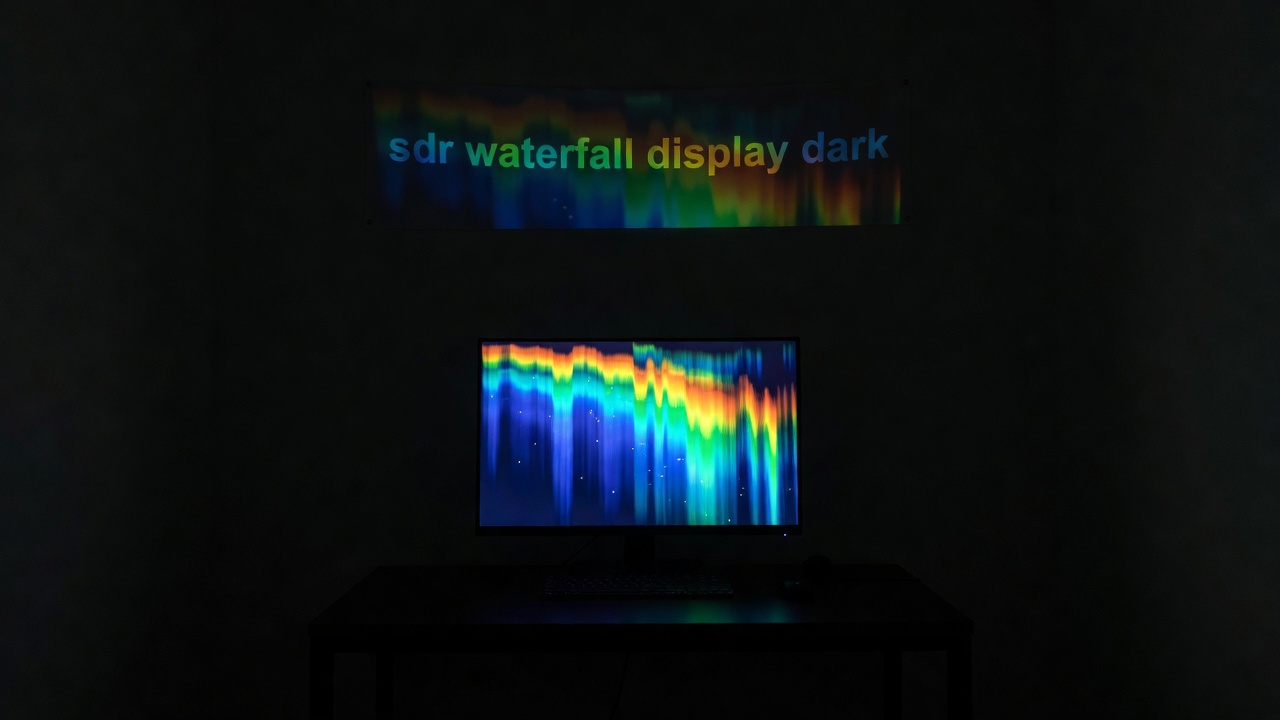
Before anything else, write down: frequency (kHz), time (UTC), mode (AM, USB, LSB, CW, data), and bandwidth (how wide the signal looks on a waterfall). These four facts solve most identifications on their own. Guessing without them wastes time.
3.2 Recognise the mode by ear and eye
- AM broadcast — music or speech, a carrier spike in the centre with sidebands either side, roughly 10 kHz wide.
- SSB voice — sounds like Donald Duck until you switch to the right sideband. Amateur convention is LSB below 10 MHz and USB above; aviation and maritime utilities use USB.
- CW (Morse) — a single thin line on the waterfall, keyed on and off.
- FT8 — dense blocks of tones in 15-second cycles near 7.074 and 14.074 MHz. Decode with WSJT-X, written by Nobel laureate Joe Taylor, K1JT.
- RTTY and other data — two or more steady tones or a warbling block. Compare against the reference library.
- DRM — Digital Radio Mondiale, a flat block about 10 kHz wide that sounds like hiss. Decode with dedicated software or a DRM-capable receiver.
3.3 Wait for the top of the hour
Broadcasters identify at the start and end of programmes, usually on the hour or half hour UTC. Interval signals — short melodies played before transmission — are fingerprints. Stay on frequency through the change of hour before you decide.
3.4 Cross-check schedules
Match frequency and time against a schedule. Core references: the EiBi shortwave schedules compiled by Eike Bierwirth and updated each season; the annual World Radio TV Handbook (WRTH); and broadcasters' own published frequency lists. If several stations share the slot, language and programme content decide it.
3.5 Use the identification wiki
For non-broadcast signals, open the Signal Identification Wiki (sigidwiki.com). It catalogues hundreds of modes with waterfall screenshots and audio samples. Compare by bandwidth and sound, not by guesswork.
3.6 Meet The Buzzer
Every listener eventually tunes 4625 kHz. There sits UVB-76, nicknamed The Buzzer: a short, harsh buzz repeated around the clock, believed to be linked to the Russian military. On rare occasions the buzz stops and a voice reads names and numbers in Russian. Hobbyists document these events and other numbers stations at Priyom.org. Listen, log the time of any voice message, and compare with community records.
3.7 Mark unknowns honestly
If you cannot confirm a station, log it as "unidentified" with your four facts and a short recording. Many identifications are solved weeks later by another listener. A wrong ID is worse than an open question.
3.8 Respect the law
Broadcasts are made for the public. Utility, aviation and private communications are not. In some countries, including the UK under the Wireless Telegraphy Act 2006, disclosing or acting on the content of messages not intended for general reception is an offence. Identify the mode; do not publish the content.
Checkpoint
You are ready for stage 04 when you can identify a broadcast by schedule and recognise at least three non-broadcast modes. Next: make every identification permanent.